Women across the world use this day to come together to celebrate and rally for equal treatment and representation it’s also a day where women are recognized for their contributions and achievements irrespective of division whether national, international, or cultural.

The theme for this year’s International women’s day 2023 is “DigitALL: INNOVATION AND  TECHNOLOGY  FOR GENDER EQUALITY “

The topic highlights not only how technology is crucial to advancing rights, but a growing digital gender gap that is impacting everything from job opportunities for women and their safety online.

According to the UN 259 million fewer women have access to the Internet than men, and women are largely underrepresented in science, technology, engineering and mathematics professions. Bringing women into technology results in more creative solutions and has greater potential for innovations that meet women’s née and promote gender equality says the UN. “their lack of inclusion by contract, comes with massive costs.

HOW DID THE INTERNATIONAL WOMEN’s DAY CELEBRATION START?

The predecessor of international women’s day previously known as NATIONAL WORKERS DAY was first observed in the United States on February 28th 1909 at the suggestion of activist THERESA MALKIEL.

The idea of an international women’s day was suggested in 1910 during an international socialist women’s conference in Copenhagen Denmark.

It was during this conference that Clara Zetkin, a German communist activist, universal suffragist and advocate of women’s rights, proposed the idea that there be a designated day for women everywhere to “press for their demands “. Her idea was met with unanimous approval from all the women representing 17th Century.

“DIGITAL: INNOVATION AND TECHNOLOGY FOR GENDER EQUALITY.

Innovation and technology change, and education in the digital age for achieving gender equality and the empowerment of all women and girls “.

Today, on international women and girls benefit from the opportunities offered by the technological transformation – but also, and above all, we need to ensure that they can help shape it, on an equal footing.

WHY IS THE INTERNATIONAL WOMEN’S DAY IS IMPORTANT

The following is the importance of women’s day.

  1. To improve equality for women in tech
  2. Elevate the visibility of women’s creativity
  3. Empower women’s choice in health. Etc.

This day also celebrates and recognizes the women and girls who are heading the acceleration of transfigurative technology and digital education.

The theme for 2023 International day of zero tolerance for female Genital mutilation is:

“PARTNERSHIP WITH MEN AND BOYS TO TRANSFORM SOCIAL AND GENDER NORMS TO END FGM”.

ENDING FEMALE GENITAL MUTILATION BY 2030

About 120 to 140 million women have been subject to FGM and 3million girls are at risk each year according to WHO.

Female genital mutilation (FGM) comprises all procedures that involve altering or injuring the female genitalia for non-medical reasons and is recognized both nationally and Internationally as a violation of the human right, the health and the Integrity of girls and women.

Although Primarily concentrated in 30 countries in Africa and Middle East, female Genital Mutilation is a universal problem and is also practiced  in some countries in Asia and Latiin America. Female genital mutilation countries to persist amongst Immigrant population living in Western Europe, North America, Australia and New Zealand.

Over the last 25 year, the prevalence of FGM has declined globally.

Today, a girl is one-third less likely to undergo FGM than 30 year ago.

However, sustaining these achievements in the face of humanitarian crises such as decease out breaks, climate change, armed conflict and more could cause a rollback of progress toward achieving gender equality and the elimination of FGM by 2030.

IMPLICATION OF FEMALE GENITAL MUTILATION (FGM)

Girls who undergo female genital mutilation face short-term complication such as:

  • Sustainable partnership with men and boys; their voice and action can transform deeply rooted gender norms.
  • Allowing girls and women to realize their
  1. Serve pain
  2. Shock
  3. Excessive bleeding
  4. Infection
  5. Difficulty in passing urine as well as long-term consequences for their sexual and reproductive health and mental health.

REMEDY TO FEMALE GENITAL MUTILATION (FGM)

With eight years remaining in this decade of action there is potential in eliminating this harmful practice through:

  1. Sustainable partnership with men and boys; their voice and actions can transform deeply rooted social and gender norms.
  2. Allowing girls and women to realize their right and potential in terms of health.
  3. Education
  4. Income and equality

Nigercare Development Aid International (NDAI) as a body of NGO go out to sensitize female students in schools and also go to communities to enlighten women on the dangers of Female Genital Mutilation (FGM).

This campaign is to raise awareness of the global pandemic of women rights violations and to fight violence against women and gender inequality. The 16 days of activism against gender based violence is an annual campaign that begins on 25 November, the international day for the elimination of violence against women and was through international Human Rights Day on December.

Date made available to the guardian, by the Lagos State Domestic and Sexual Violence Agency (DSVA), should that a total of 2,543 cases of abuse were reported between January and September, 2022. Of this number, 2.340 are women, while 1,692 of the victims are married, 323 are single, 206 are co-habiting and 322 are undecided.

Within the period the report covered, Alimosho Local Council recorded the highest number of cases in each of the months. A total of 1,859 cases of domestic violence; 78 cases of threat to life; 38 cases of sexual harassment; 54 cases and 143 cases of sexual and gender-based violence (SGBV).

THIS YEARS THEME OF THE 16 DAYS IS “ORANGE THE WORLD”

UNITE! Activism to end violence against women and girls will aim to mobilize all society to become activists for the prevention of violence against women, to stand in solidarity with women’s right activists and support feminists movement around the world to resist the rollback on women rights and calling for a world free from VAWG.

WHY WE MUST ELIMINATE VIOLENCE AGAINST WOMEN

Violence against women and girls (VAWG) is one of the most widespread, persistent and devastating human right violations in our world today remains largely unreported due to the impurity, silence, stigma and shame surrounding it.

In general terms, it manifests itself in physical, sexual and psychological forms, encompassing;

  1. Intimate partner violence (battling psychological abuse, marital rape, femicide)
  2. Sexual violence and harassment (rape, forced sexual acts,unwanted sexual advance, child sexual abuse, forced marriage, street harassment etc.
  3. Human trafficking (slavery, sexual exploitation)
  4. Female genital mutilation
  5. Child marriage

REMEDY/PREVENTION OF VIOLENCE AGAINST WOMEN

Violence against women can be prevented by strengthening women’s access to basic human rights and resources such as;

  1. Access to education
  2. Health care
  3. Affordable child care and elderly care
  4. Equal opportunities should be given to both genders

Our yearly activities were remarkably brought to an end by a care outreach for widows in our community. We provided them with free eye care services, foodstuff, and monetary gifts that were generously provided by our sponsors. We are excited that we were able to bring smiles to their faces, and contribute to their joy in this festive season. We remain committed to the empowerment of Women, youth, and children, and we will continue to contribute our quota to this course.
We want to immensely thank our sponsors who have helped us achieve our goals for this year as an organization. We can not thank you enough for your financial and moral support. While we are grateful for a beautiful 2021, we look forward to an even better 2022.

The girl-child is a simple girl living an ordinary life; not so special nor extraordinary.

In her world, girls and women are not given equal access to education due to reasons like pregnancy, violence at school, lack of funding, disabilities, child labour, poor sanitation etc.

The girl-child has her life planned out for her; it’s go to school – get married – give birth to children. When she reaches the age of 12-14 years, the elders of the community feel she is “ripe for marriage” and their words are law.

The native traditional philosophy is that a woman’s place is in her husband’s kitchen and her primary role centres on home.

The girl-child dreams of the future she wants to have.

She hopes to be seen and heard by society.

When she is educated, she realizes the full potentials endowed in her; she discovers to be whoever and whatever she wants to be.

With education, she will break the shell of ignorance and open that of self discovery.

The girl-child is the woman in the girl, the girl in the woman.

When given the right chance to nurture her talents and skills needed for social interaction and self-improvement, she has it in her to excel in different areas of life.

The girl-child is your daughter, your sister, your mother, your aunt, your grandmother, your friend, your colleague.

The girl-child is you!

Girls are leaders. Girls are change-makers. Girls are driving good and growth around the world. They are a fundamental source of transformational change for gender equality, and technology is a crucial tool to support their work, activism and leadership ( UN Women 2021).

Every year on the 11th of October, we celebrate the The International Day of the Girl Child. This year’s theme is “Digital generation. Our generation”.

The world is driven by technological innovation and it is important that the Girl Child is not left behind. Traditionally, girls are discouraged from taking up subjects in STEM because they are groomed from the cradle to end up as just wives and mothers.

According to a report by Martin Luenendonk, women hold only 25% of all the jobs in the tech industry, 83% of boys in secondary school opt for STEM subjects, while only 64% of girls opt for STEM subjects. This disparity is also evident in the University, whereby 52% of males take STEM related courses, in contrast to only 30% females. He went to to explain that, females do not consider a tech career because it is not being put forward as one of the options they can take, this is to further buttress the stereotype that the tech industry is a man’s world.

We are joining hands with other organizations and civil societies to call for the proper education of female students about tech and its role in shaping the world. We are also engaging in ways to completely eradicate the stereotype that portrays tech as a career for only males; and ensuring that girls are exposed to more dialogues on careers in STEM and why they should be part of the train of Technology.

#InternationalDayOfTheGirlChild
#DigitalGenerationOurGeneration
#techgirls
#Girlsfortech
#UNWomen
#girlpower

Defined as marriages involving people below 18 years of age, child marriages violate children’s rights to protection from harmful practices. They expose them to risk of Gender Based Violence (GBV) and sexual abuse and also limit career options of girls who tend to become stay-at-home parents after falling pregnant. The teenage pregnancies themselves pose serious health risks which often result in birth complications or even death. Child marriages are thus a plague Africa needs to shake off.

However, despite the well-documented adverse effects, child marriages are still the norm in a lot of African communities. In the COVID-19 pandemic, they’ve actually increased along with other forms of Violence Against Women and Girls (VAWG). UNICEF reports that an additional 10 million girls are at risk of child marriage in the pandemic and this risks reversing gains made in the past on reducing the scourge of child marriage in Nigeria which has the 11th highest rate of child marriages globally.

What can be done?

Defining, discussing and pontificating on the problem helps no one. If you are reading this you likely care enough to have researched the statistics. You likely already know that poor rural communities are most at risk, that child marriages are fuelled by ignorance of their harms and that religion or culture are used as the go-to excuses. There’s countless studies talking about that. But information on how communities can help is severely lacking.

At the grassroots level, community members can reduce incidences of child marriages by educating parents and children on the dangers of child marriage. Having legal instruments like the African Charter on the Rights and Welfare of the Child or the Child’s Rights Act of 2003 in Nigeria is not enough to end the injustice. In rural communities and fundamentalist families, there is a strong incongruence between what laws say and what people believe and do. And this is where a large part of the problem lies: there is only so much governments can do to protect people when the very people being protected don’t realise they’re being harmed. People are more likely to resist progressive laws whose import they don’t appreciate.

The Marange community in Zimbabwe is a prime example of how winning hearts and changing community beliefs is essential to ending child marriages. Zimbabwe has one of the most progressive constitutions in terms of child rights and the legal framework is strongly against child rights violation like child marriage and sexual exploitation. Yet girls as young as 11 years are married off to older men en masse. There’s thus strong need for those with more access to information to actively spread it in Nigeria because advocating for strong policies alone aren’t enough to protect children. Civil society organisations like ourselves must create peer educator networks where community members of all ages are trained to educate peers. These have successfully been launched in African countries similar to Nigeria with great results as people are predisposed to listen more to peers than outsiders when it comes to dismantling abusive systems and forsaking harmful practices.

While educating communities, there is strong need for peer educators to be trained on how to raise awareness even among religious fundamentalist communities like the Hausa-Fulani tribe in the North. Religion and culture continue to be used as justifications for child marriage, some States still haven’t even implemented the Child’ Rights Act arguing that it conflicts with Shari’a law and local customs. So, beating around the bush and ignoring the harmful impacts of toxic religious beliefs which condone abuse will only stall efforts. Religious leaders in these communities must be engaged, educated and won over as supporters of the fight to end child marriage. It is their duty to guide communities spiritually and in daily life. This duty must also involve working to end child marriages in Nigeria.

In addition, there’s need to create Community Support Groups for survivors of child marriage. Children who are married off often face isolation, stress-related mental health challenges and stay with abusers out of fear of destitution since their families usually aren’t welcoming should they try to escape. Community support groups are thus integral in the fight against child marriage. They’ll work to identify cases of abuse, report to relevant authorities, rescue survivors and give them the support they need to live healthy lives proceeding with education. Incorporating survivors of the abuse will also ensure these use their harrowing experiences to raise awareness on the injustices of child marriage. Giving them a platform to tell their story like this will increase effectiveness of anti-child-marriage programs by touching more hearts and encouraging behaviour change.

We must also campaign for policy change at state level. By advocating better child protection policies and their indiscriminate enforcement, a lot of good can be done, especially in the Nigerian North where child marriages are highly prevalent. The remaining 10 state legislatures that haven’t adopted the Child’s Rights Act must be pressured by community advocacy groups to adopt it in its full spirit of ensuring the girl child is protected. Among those that only partially implemented, there is also need to pressure leaders into fully implementing the Act. Religion and culture must never supersede progressive laws to protect children. Religions and cultures both exist to make human existence less unbearable and communities must be vigilant in getting this point across to policymakers.

Looking at the rates of child marriages in Nigeria, ending child marriages seems like a mammoth task. But it can be done. Communities with empathetic, informed and vigilant members are making significant strides the world over. Nigeria can do it too if we all make concerted efforts: communities work at grassroots level, while States enact strong laws and work to end the poverty that also contributes to perpetuation of child marriages.

Written by: McAuthur Mkwapatira

McAuthur Mkwapatira is a Social and Economic Justice Activist, Community Advocacy Officer, Writer and strong believer in the power of informed, empathetic and vigilant communities.

What are digital generations? You can look at it from several viewpoints. As a singular view, a digital generation can be considered as encompassing only people who were born into or raised in the digital era, meaning with wide-spread access to modern-age technology such as smartphones, tablets, computers, and digital information like the internet.

One can also say that digital generation is the generation of humans whose generational location places their birth and developmental experiences during a time of widespread access to digital computing technologies and whose exposure to and experience with those technologies led to a technological comfort and expertise with those technologies that surpasses those of prior generations. 

But for this overview, we prefer the viewpoint that every living person today be it a woman or a man can be considered part of a digital generation, because — no matter how much we engage with technology — we are living in a digital-first world.

Of course, the degree to which each person is comfortable and willing to embrace technology is also dependent on his/her willingness to involve with the trend.

   In this article we will be seeing how we could strike a balance on the gender inequality on the access to digital life (access to technology and the internet) .

The digital divide, or technology gap, is the difference between groups with access to technology and the internet and those without.

Girls and women often have less access to technology and the internet compared to boys and men. Particularly in developing countries, girls and women struggle to afford technology and internet access. In addition, stereotypes around technology being ‘for boys’ and fear of being discriminated against stop girls from using digital tools.

Without equal access to technology and the internet, girls and women are not able to equally participate in our ever more digital societies. Holding back girls and women in this area affects every aspect of their lives, including their ability to speak out and campaign on issues that affect them.

Moreover, if girls and women are not involved in creating digital tools and online content, they may exacerbate existing inequalities. 

The gender technology gap also negatively impacts countries’ potential for economic growth and development. Imagine if 600 million more women are connected to the internet in 3 years, this would translate to a spontaneous rise in global GDP.

The Benefits Of Digital Empowerment.

Digital literacy has become almost as important as traditional literacy.

Over 90% of jobs worldwide already have a digital component* and most jobs will soon require sophisticated digital skills. If governments equip girls with digital skills through prioritising education in ICT subjects, they will help girls thrive in economies where routine work has been automated and digital skills are prized.

Digitalization offers a variety of opportunities for female empowerment and for a more equal female participation in labour markets, financial markets, and entrepreneurship. Currently, digitalization seems to favour female labour force that faces lower risk of being replaced by machines, as compared to male labour force. Women’s often superior social skills represent a comparative advantage in the digital age, and this is particularly so when social skills are complemented with higher education and advanced digital literacy.

Technology can also be a powerful tool for girls to become activists and lead change on issues that affect them. Social media platforms, for instance, allow activists to reach a wide audience and organise action towards common causes.

In conclusion we must harness the power of technology and use innovative solutions to extend our reach and impact. We must focus on the rights of girls, who are most vulnerable to being left behind as the world around us changes.”

It is our responsibility to ensure that instead of being barriers, technology and the internet become enablers for girls and women.

School is often the first place where children are introduced to technology as well as learning the literacy and numeracy skills to make the most of these digital tools. Therefore, we ensure girls and women have equal access to learning relevant technical skills and digital literacy in school and through training programmes to be able to take advantage of technology and digital tools.

Through our global, international day for the girl child, with the theme “Digital Generation” we are campaigning for a world where girls can live and lead without fear or discrimination. This includes demanding that girls have a right to be safe online and be free to speak up without harassment.

We celebrated World Menstrual Hygiene day with girls from Imo Government Girl’s Secondary School Owerri.

This year’s theme centred on Action and Investment in Menstrual Hygiene and Health.

The girls were educated on the importance of proper hygiene especially when they are menstruating. They were enlightened on the need to drop the stigma associated with being on their period.
It was a really beautiful outing as each girl went home with sanitary packs.

We all have a role to play to ensure that we create a world without period poverty and stigma. We must make sure we play a role and be part of this movement.

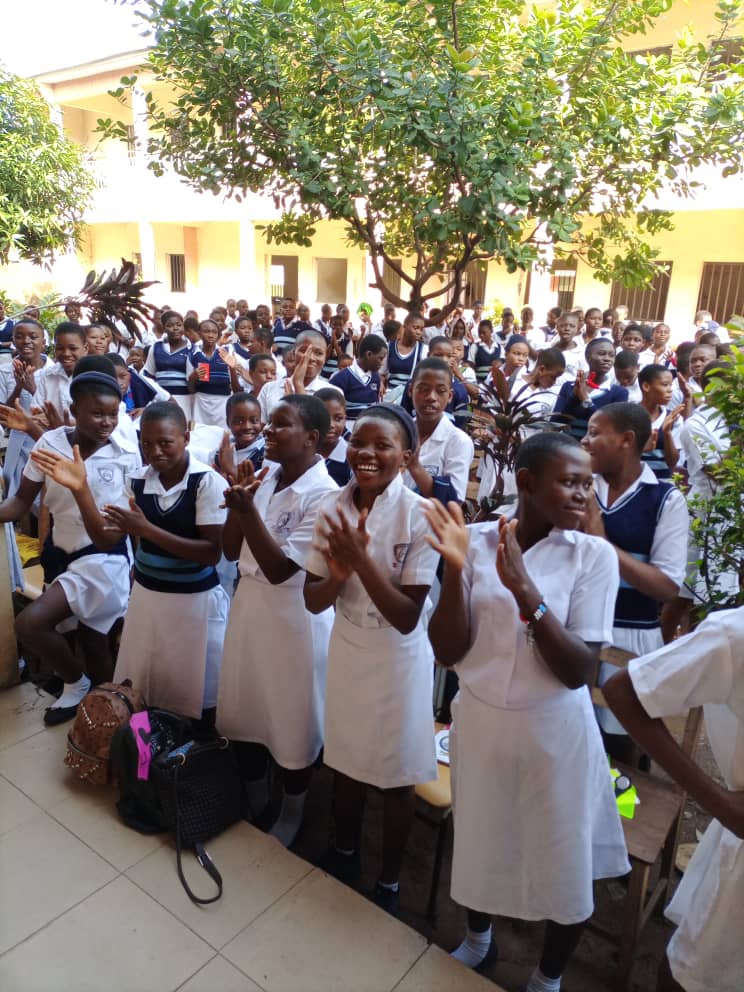
It was an exciting event today at the Girls Secondary School, Ikenegbu, Owerri. We interacted with the girls and enlightened them on the need to assert their power as change makers in the society.

The girls were excited, and expressed their joy to be part of a generation where girls are breaking boundaries and barriers posed by stereotypes and exclusion. They talked about how they will become entrepreneurs and innovators, thereby creating a world that will be relevant for them and future generations.

After today’s event, the girls were poised and certain to take on the future and prove they are unstoppable.

We were able to distribute sanitary wears to each of the girls, and we wouldn’t have been able to do that without the help of our sponsors. Thank you so much for your love and support.